Why Christianity? What Is Different? What Is Special?
Introduction
Why Christianity? What is different or special about Jesus? Many religions encourage moral living, self-discipline, generosity, and service. But Christianity makes distinctive claims about Jesus Himself: God entered His creation, died for our sins, rose bodily from death, and reigns as Lord.
Those claims matter because they concern more than a religious label or a moral code. The biblical Jesus offers forgiveness, reconciliation with the Father, new birth, a new identity, transformation by grace, and the Spirit’s power to serve. A description of Jesus that denies His divine identity, atoning death, or bodily resurrection cannot offer the same explanation of how those promises are accomplished.
This article considers what historic Christianity claims about the real Jesus, what is at stake when His identity or work is changed, and how we can respond by trusting and following Him.
Scripture quotations are from the New King James Version (NKJV). Ellipses (…) indicate omitted words at the beginning, middle, or end of a Scripture quotation.
What: What Makes Christianity Different and Special?
Religions can share familiar features such as moral teachings, sacred texts, communities, and practices while disagreeing over their most important claims. For this study, the decisive issue is who Jesus is and what His life, death, resurrection, and lordship accomplish. First we identify the defining Christian claims; then we consider their practical consequences.
Key Verse: John 14:6 – “…I am the way, the truth, and the life. No one comes to the Father except through Me.”
The Critical Features of Historic Christianity
What makes Christianity distinctive is not simply that Jesus taught people to live morally. Historic Christianity makes specific claims about who He is and what He accomplished. These foundational truths explain why His identity, sacrifice, resurrection, and present ministry matter to our relationship with God. The following table connects each claim with its biblical foundation.
| Critical Feature | What Christians Believe | Key Scripture |
|---|---|---|
| God entered creation as a man—Jesus | The eternal Word became flesh. Jesus is fully God and fully human. | John 1:1 – “…the Word was God.” John 1:14 – “And the Word became flesh and dwelt among us…” |
| Jesus suffered and died for our sins | The innocent Son willingly gave His life to reconcile us to God. | 1 Peter 3:18 – “For Christ also suffered once for sins, the just for the unjust, that He might bring us to God…” |
| Jesus rose bodily from death | His tomb was empty; His resurrection was not merely symbolic or an immaterial survival. | Luke 24:39 – “…a spirit does not have flesh and bones as you see I have.” |
| Our founder lives and reigns | Jesus ascended and reigns as Lord. | Revelation 1:18 – “…I am alive forevermore. Amen…” |
| Jesus is our unique mediator | Reconciliation with the Father is accomplished through Him. | 1 Timothy 2:5 – “For there is one God and one Mediator between God and men, the Man Christ Jesus,” |
| Forgiveness and reconciliation through His blood | Sin is addressed through Jesus’ sacrifice, and those far away are brought near to God. | Ephesians 2:13 – “…you who once were far off have been brought near by the blood of Christ.” |
| New birth begins now | We can become new creations and receive eternal life in this life. | 2 Corinthians 5:17 – “Therefore, if anyone is in Christ, he is a new creation…” |
| God dwells in believers | The Father and Son make their home with the believer through the Holy Spirit. | John 14:23 – “…We will come to him and make Our home with him.” |
| Jesus will return and judge | His rule and authority have eternal consequences. | Acts 17:31 – “…He will judge the world in righteousness by the Man whom He has ordained…” |
Taken together, these teachings make a claim far beyond a new set of religious rules: the living Jesus is both the One who rescues us and the Lord who restores our relationship with God. That is why different accounts of His identity cannot simply be treated as interchangeable.
These Are Not the Same Jesus—or the Same Gospel
Judaism does not accept Jesus as the Messiah or God in the flesh. Islam honors Him as Messiah and prophet but rejects His deity and His crucifixion. Jehovah’s Witnesses affirm His death as a ransom and His present heavenly rule but reject His identity as Almighty God and His bodily resurrection. Some early groups called Docetists denied that Jesus ever had a genuinely human physical body.
These are distinct religious claims, not minor differences in wording. Judaism, Islam, and Jehovah’s Witnesses should each be described on their own terms, without implying that every adherent holds identical views. Hinduism and Buddhism also contain considerable diversity and do not generally have one binding doctrine of Jesus comparable to the historic Christian creeds.
The practical question is this: if a religious account changes Jesus’ identity or denies His saving work, what happens to the forgiveness, reconciliation, new life, and eternal hope that Christianity says depend on Him?
Jesus’ Question to the disciples is even more pertinant for you to answer:
Matthew 16:15 – “…But who do you say that I am?”
Christianity Offers More Than a Moral Code
These claims have practical consequences. Religions may share moral expectations while differing significantly in how they understand God, forgiveness, salvation, new life, and inward transformation. The following comparison identifies the teaching of historic Christianity and explains the significance of each distinction, without suggesting that other faiths lack moral insight or practices of self-discipline.
| Differentiator | Historic Christian Teaching | Why It Matters |
|---|---|---|
| Identity of God | One God—Father, Son, and Holy Spirit; God entered creation as Jesus Christ. | Jesus reveals the Father personally. |
| Forgiveness, justice, and mercy | Jesus’ innocent blood atones for sins and brings forgiveness; Christians understand the atonement through several complementary biblical frameworks. | God is both just and merciful; we need not pretend guilt never existed. |
| Basis of salvation | Salvation is God’s grace through Jesus, not something we earn by human merit alone. | Our relationship with God begins with His initiative and saving work. |
| When new life begins | Through Christ, spiritual rebirth and eternal life begin now. | We do not simply wait for death to discover whether God accepts us. |
| Relationship with God | Believers are reconciled, welcomed as children, and indwelt by the Holy Spirit. | We are invited into an ongoing relationship, not merely rule-following. |
| Good works | Good works flow from grace and a transformed life. | We serve because God has loved and restored us, not to purchase His favor. |
| Transformation by grace | Renew the mind with God’s truth; deny ungodly desires; put off the old and put on the new in Christ. God works within us by His Spirit. | Christ restores the inward drivers of our thoughts, emotions, and behavior—not merely outward conduct. |
The central contrast is not that Christians perform good works and everyone else does not. It is that Christianity locates reconciliation, new birth, and the beginning of eternal life in God’s saving action through Jesus, with faithful living growing out of that restored relationship.
Why: Why Does It Matter Which Jesus We Believe In?
Why insist on the biblical Jesus rather than accepting any religious description that uses His name? Because the Christian gospel depends on what Jesus actually is and what He actually accomplished. If He did not become flesh, die for our sins, rise bodily, and reign as Lord, the foundations for the promised forgiveness, reconciliation, new birth, transformation, and eternal hope are changed.
God’s original design was for humanity to live in relationship with Him, receive His love, reflect His character, and fulfill His purposes. Sin disrupted that relationship. We often try to fill the resulting void with status, possessions, achievement, or self-protection, yet none of these can reconcile us to God or give us new spiritual life.
Christianity claims that the real Jesus does what moral instruction and self-effort cannot do: He addresses the sin that separates us from God, makes us His children, gives us His Spirit, and leads us into a new life of love and service. The next comparison focuses on these concrete consequences of His identity and work.
What We Receive Through the Biblical Jesus—and What Would Remain Unresolved
These benefits are not peripheral bonuses to Christian belief. They are the very reasons Jesus’ identity and work matter. The table starts with each gift promised through the biblical Jesus, identifies the spiritual problem that remains unresolved if that part of His saving work is denied, and connects the teaching to Scripture. A different description of Jesus may share some moral teachings or titles while rejecting a claim on which these benefits depend.
| What the Biblical Jesus Makes Possible | What Remains Unresolved Without His Saving Work | Key Scripture |
|---|---|---|
| Forgiveness and cleansing — His innocent blood atones for our sins. | Sin and guilt remain — Our works cannot erase past sin. | Ephesians 1:7 – “In Him we have redemption through His blood, the forgiveness of sins…” |
| Reconciliation with the Father — We draw near and gain access to His love and grace. | Separation remains — Relationship with the Father is not restored through Christ. | Ephesians 2:13 – “But now in Christ Jesus you who once were far off have been brought near by the blood of Christ.” |
| Born again into new life — Eternal life begins now. | Spiritual death remains — We lack the new life Jesus promises. | John 5:24 – “…he who hears My word and believes in Him who sent Me has everlasting life…” |
| Jesus becomes Lord — We surrender self-rule and follow His leadership. | Self remains in control — Our desires and limited understanding dominate. | Luke 9:23 – “…If anyone desires to come after Me, let him deny himself, and take up his cross daily, and follow Me.” |
| Internal transformation by grace — Our hearts, minds, desires, and character are renewed. | The fallen nature remains dominant — We rely on self-effort alone. | Philippians 2:13 – “for it is God who works in you both to will and to do for His good pleasure.” |
| Spirit-led empowerment for sacrificial service — We walk in love and bring God glory. | Our God-given purpose remains unfulfilled — We lack this restored Spirit-led partnership. | Galatians 5:13 – “…through love serve one another.” |
| Eternal life and inheritance — We have resurrection hope and an inheritance with Christ. | Death remains undefeated — We lack resurrection hope through Christ. | John 11:25 – “…I am the resurrection and the life. He who believes in Me, though he may die, he shall live.” |
The point is not that people outside Christianity cannot love others, serve sacrificially, or live morally. The distinction is that Christianity grounds forgiveness, restored sonship, life in the Holy Spirit, and resurrection hope in the real person and finished work of Jesus. Denying His deity, His atoning death, or His bodily resurrection changes that gospel foundation.
Grace: Acceptance at the Beginning, Good Works as the Fruit
Think about the difference between entering a relationship and living out that relationship. A wedding begins a marriage covenant; it does not follow decades of flawless marital performance. The couple then spends a lifetime learning to love, trust, forgive, and serve one another. That illustration is imperfect, but it captures a central point: Christian good works belong to the life that flows from God’s grace; they do not purchase the relationship.
Ephesians 2:8–9 – “For by grace you have been saved through faith, and that not of yourselves; it is the gift of God, not of works, lest anyone should boast.”
The very next verse describes us as God’s workmanship, created in Christ for good works (Ephesians 2:10). Historic Christian traditions differ in how they explain faith, justification, sacraments, and cooperation with grace. They nevertheless affirm that salvation originates in God’s grace through Jesus Christ, not autonomous human achievement.
The sequence is important: God calls us; we respond in faith; through Christ we are accepted and enter peace with God; we receive eternal life beginning now; we walk together with Him, bearing fruit in good works; and physical death does not end that relationship. John 5:24 describes eternal life as a present possession, not merely a possibility to be evaluated after death.
Christ Reconciles Justice and Mercy
Consider a courtroom illustration: a driver has broken the law. The violation is real; a judge cannot simply pretend it did not happen. The judge nevertheless has mercy on the offender and personally pays the penalty. The driver is released because the debt has been paid, not because the offense was imaginary.
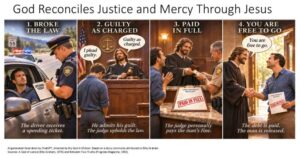
The illustration communicates the substitutionary dimension of Jesus’ sacrifice: sin has real consequences; God is righteous and merciful; and Jesus acts to reconcile us to the Father. Like every analogy, it is incomplete. The biblical atonement also speaks of victory over sin and death, reconciliation, liberation, and restored covenant relationship.
1 Peter 3:18 – “For Christ also suffered once for sins, the just for the unjust, that He might bring us to God…”
The Door and the Narrow Road
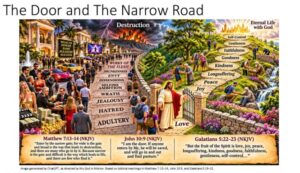
Jesus warned that the broad road attracts many people but leads to destruction, whereas the narrow gate and difficult road lead to life. He also described Himself as the door through which His sheep enter and find pasture. These are distinct biblical teachings combined in our illustration to show the choice of whom to follow.
Matthew 7:13–14 – “Enter by the narrow gate; for wide is the gate and broad is the way that leads to destruction…”
John 10:9 – “I am the door. If anyone enters by Me, he will be saved, and will go in and out and find pasture.”
The broad road offers wealth, pleasure, status, possessions, and control. Such things are not all sinful in themselves, but they become destructive when they displace God. The works of the flesh include hatred, jealousy, wrath, selfish ambitions, envy, and other ungodly behavior (Galatians 5:19–21).
The narrow path through Jesus rises toward life with God. Its paving stones depict the fruit of the Spirit: love, joy, peace, longsuffering, kindness, goodness, faithfulness, gentleness, and self-control (Galatians 5:22–23). The nearby actions of care, help, and sacrificial service show the fruit being put into practice. We do not earn entrance by doing good deeds; we enter through Jesus, then grow in His character and walk in the good works prepared for us.
How: Find and Follow the Real Jesus
Christian faith does not require blind acceptance of an unsupported story. We can examine the historical evidence, consider what the earliest followers claimed, and evaluate the identity, death, and resurrection of Jesus. Yet knowing about Jesus is not the same as responding to His call. The goal is to move from discovery into a lifelong relationship of trust and discipleship.
Investigate the Evidence
Belief in Jesus begins with a question we can investigate: are the claims about His historical existence, identity, death, and resurrection credible? Different lines of evidence answer different parts of that question. The following categories provide a disciplined starting point rather than assuming that one piece of evidence proves every Christian doctrine.
| Evidence to Consider | Question to Explore |
|---|---|
| Non-Christian Historical Attestation | What do ancient non-Christian authors tell us about Jesus, His execution, and His followers? |
| Messianic Prophecy and Fulfillment | How does Jesus correspond to the Old Testament expectations of the Messiah? |
| Gospel Historical Reliability | What are the sources, dates, historical details, and corroboration of the Gospel accounts? |
| Textual Criticism and Manuscript Evidence | How accurately can we recover the words ancient New Testament authors wrote? |
| Eyewitness and Apostolic Testimony | What did the earliest witnesses claim to have seen, and how credible are those reports? |
| Evidence for the Resurrection | What best explains the earliest resurrection proclamation, reported appearances, and empty-tomb traditions? |
These are different kinds of investigation. Historical evidence strongly supports the existence and crucifixion of Jesus. Evaluating the resurrection and the theological claim that Jesus is God in the flesh involves additional interpretation and competing explanations. The Bible itself contains testimony to be studied, not simply assumed as historical proof.
John 20:31 – “…these are written that you may believe that Jesus is the Christ, the Son of God…”
For a more detailed investigation, see Why Believe in Jesus? There Is Plenty of Evidence! and Why Should You Believe in Jesus and His Resurrection?.
From Discovery to Discipleship
The purpose of examining the evidence is not simply to accumulate information about Jesus. The Gospel calls for a personal response and a continuing relationship. The five movements below show how discovering His identity leads to answering His call, receiving God’s love, being transformed by grace, and flowing that love to others.
| Movement | Our Response | Key Scripture |
|---|---|---|
| Discover Who Jesus Is | Examine the evidence that He was a real historical person, is God in the flesh, died for our sins, and rose again. | John 20:31 – “…that you may believe that Jesus is the Christ, the Son of God…” |
| Respond to His Call | Recognize His offer of eternal life. Repent, believe, trust Him, and submit to His lordship. | Romans 10:9 – “…if you confess with your mouth the Lord Jesus and believe in your heart that God has raised Him from the dead, you will be saved.” |
| Receive God’s Love | Understand His finished work; receive forgiveness, reconciliation, new birth, and love; stand in your identity as a born-again child of God. | John 1:12 – “But as many as received Him, to them He gave the right to become children of God…” |
| Be Transformed by Grace | Renew your mind, deny yourself, take up your cross daily, put the old self-centered ways to death figuratively, and put off the old and put on the new. | Romans 12:2 – “…be transformed by the renewing of your mind…” |
| Flow God’s Love to Others | Follow His lead, walk in love, serve sacrificially, pursue the good works prepared, shine as a beacon, and bring God glory. | Galatians 5:13 – “…through love serve one another.” |
This progression is a teaching framework, not five separate ways to earn salvation. God invites us, we respond, and we continue receiving His love, being transformed by His grace, and flowing that love to others. Hearing His voice and following His lead continue throughout the journey.
In the fourth movement, transformation goes deeper than restraining unwanted behavior. We ask God to expose the beliefs, fears, and self-centered desires driving it, renew our thinking with His truth, and put off the old way while putting on the new. Romans 12:2, Ephesians 4:22–24, and Philippians 2:13 show the relationship between renewing our minds, choosing a different way of life, and God working within us by grace.
What Keeps Us from Finding and Following the Real Jesus?
Some barriers involve evidence and understanding. Others arise from our loves, fears, or unwillingness to yield. The purpose of examining them is not condemnation, but recognizing the ungodly belief or desire that needs to be replaced by God’s truth.
| Barrier / Ungodly Belief | Truth to Embrace | Key Scripture |
|---|---|---|
| Unbelief / Misinformation “There is no credible evidence for Jesus.” |
God has provided testimony and evidence to investigate. | John 20:31 – “…these are written that you may believe that Jesus is the Christ, the Son of God…” |
| Competing Religious Claims “All versions of Jesus are equally valid.” |
Jesus’ identity matters; He is the way to the Father. | John 14:6 – “…No one comes to the Father except through Me.” |
| Pride / Self-Sufficiency “I am good enough; I do not need a Savior.” |
All have sinned; we need the salvation Jesus offers. | Romans 3:23 – “for all have sinned and fall short of the glory of God,” |
| Fear of Surrender “If I give Jesus control, I will lose what matters to me.” |
Jesus is trustworthy; following Him leads to true life. | Matthew 16:25 – “…whoever loses his life for My sake will find it.” |
| Guilt / Condemnation “My sins are too great to forgive.” |
In Christ there is forgiveness and freedom from condemnation. | Romans 8:1 – “There is therefore now no condemnation to those who are in Christ Jesus…” |
| Unworthiness / Rejection “God could never love or accept someone like me.” |
Through Christ we are welcomed as God’s children. | John 1:12 – “But as many as received Him, to them He gave the right to become children of God…” |
| Attachment to the Old Self “I cannot change, or I do not want to give up my old ways.” |
God makes us new and empowers transformation. | 2 Corinthians 5:17 – “Therefore, if anyone is in Christ, he is a new creation…” |
| Self-Reliance “I must overcome my weaknesses through my own strength.” |
God works in us to change our desires and empower obedience. | Philippians 2:13 – “for it is God who works in you both to will and to do for His good pleasure.” |
| Self-Centered Priorities “My life, my happiness, my goals, my way.” |
We were created in Christ for God’s purpose and good works. | Ephesians 2:10 – “For we are His workmanship, created in Christ Jesus for good works…” |
| Fear of Sacrifice / Rejection “Following Jesus and serving will cost too much.” |
He calls us to serve others in love. | Galatians 5:13 – “…through love serve one another.” |
Sincere questions and uncertainty are not automatically rebellion. Investigate honestly, seek counsel, examine Scripture, and remain willing to change what you believe or how you live as understanding grows.
Recognizing the barrier is the first step, not the final step. Once we identify the belief, fear, or competing desire, we can bring it before God, embrace the corresponding truth, and examine how we are actually responding in each part of our journey with Jesus.
How Am I Doing? Am I Truly Following the Real Jesus?
Having examined both the journey and the barriers, we can now evaluate our personal response. This is not an examination of whether we have earned God’s acceptance. Instead, the questions below help us distinguish knowing facts about Jesus from trusting Him, receiving what He has done, and following His leadership.
| Movement | Personal Self-Test | Key Scripture |
|---|---|---|
| Discover | Do I believe He is God in the flesh, died for my sins, and was bodily raised? What do I still need to investigate? | John 20:31 – “…that you may believe that Jesus is the Christ, the Son of God…” |
| Respond | Have I repented of my self-centered life, trusted Jesus, and submitted to His lordship? | Luke 6:46 – “But why do you call Me ‘Lord, Lord,’ and not do the things which I say?” |
| Receive | Am I receiving His forgiveness and love and living from my identity as His child? | 1 John 3:1 – “Behold what manner of love the Father has bestowed on us, that we should be called children of God!” |
| Be Transformed | Am I allowing God to renew my thinking, put to death ungodly desires, and put off the old and put on the new? Am I seeing change by grace? | Philippians 2:13 – “for it is God who works in you both to will and to do for His good pleasure.” |
| Flow to Others | Am I asking, listening, following His lead, serving others in love, and bringing Him glory? | John 15:8 – “By this My Father is glorified, that you bear much fruit; so you will be My disciples.” |
This self-test is an invitation to recognize where we are growing and where we need God’s help, not a scorecard for earning His love.
Declaration: I Believe in the Biblical Jesus and Will Follow Him
Transformation begins by renewing our minds with God’s truth (Romans 12:2). As we hear and understand His Word, faith grows (Romans 10:17). Speaking that truth aloud helps us articulate and test our understanding. If we struggle to say something with conviction, we may not fully understand or believe it. That hesitation invites us to dig deeper, examine what is holding us back, and seek God’s perspective. When the words align with Scripture and resonate as truth, they can move from intellectual understanding into deeply held beliefs and convictions in our hearts.
Speaking is also an act of volition. We deliberately engage our bodies, invest energy, and give audible expression to what we believe. We move beyond merely considering God’s truth to intentionally aligning our will and physical actions with it. Speaking becomes an initial outward expression of faith, preparing us to follow through in how we think, speak, and act. Isaiah 55:11 assures us that God’s Word does not return to Him void but accomplishes His purpose.
Read the following declaration carefully. Consider each statement, confirm that it agrees with Scripture, and notice any words you struggle to speak with conviction. If something does not ring true, investigate it rather than simply repeating it. Once you understand and embrace God’s truth, declare it aloud in faith, committing to live accordingly.
Heavenly Father,
I believe Jesus Christ is God in the flesh, the promised Messiah and Son of God.
I believe He died on the cross for my sins, shed His innocent blood for my forgiveness, and was bodily raised from the dead. He is alive and reigns as Lord over heaven and earth.
I receive Jesus as my Savior and submit to Him as my Lord.
Through His finished work, I receive forgiveness, reconciliation with the Father, new birth, and my identity as a beloved child of God.
I will trust Him and follow His lead. I will deny myself, take up my cross daily, renew my mind, and allow His grace to transform my heart, desires, and behavior.
Empowered by the Holy Spirit, I will walk in love, serve others sacrificially, fulfill my God-given purpose, and bring glory to the Father in all I do.
I speak this in Jesus’ name, Amen.
Where to Learn More
This article focuses on why the biblical Jesus matters and the new life He offers. For a deeper examination of historical evidence and the resurrection, consult the two dedicated evidence articles below. The other resources explore the practical side of knowing God, hearing His voice, and following His lead.
- Why Believe in Jesus? There Is Plenty of Evidence! — historical references, prophecy, Gospel reliability, testimony, and resurrection arguments.
- Why Should You Believe in Jesus and His Resurrection? — an earlier, more focused discussion of Jesus’ identity, prophecy, death, and resurrection.
- Why Did Jesus Come? — the purposes of Jesus’ coming, His saving work, and our response.
- God Is Speaking, Tune In, Hear His Voice, Follow His Lead — recognizing and responding to God’s guidance.
- Ask for a Word of Wisdom — asking God for guidance with a specific situation.
- Hear God’s Voice via Interactive Journaling — a practical approach to asking, listening, recording, and discerning.
- Change Your Pictures, Change Your Life — replacing limited pictures of life with God’s perspective.
For firsthand biblical accounts, read John 1, Luke 24, 1 Corinthians 15, Romans 5, Galatians 5, and Ephesians 2. You can also explore the My God in Motion Bible Study Archive.
Call to Action: Take Your Next Step with the Real Jesus
Identify where you are in your journey with Jesus, recognize what may be holding you back, and take one intentional step forward.
| Where Are You? | Your Next Step |
|---|---|
| Discover Who Jesus Is | Investigate the evidence. Resolve a question or misconception about His identity, crucifixion, or resurrection. |
| Respond to His Call | Repent, believe in Jesus, trust Him as Savior, and submit to His lordship. |
| Receive God’s Love | Understand His finished work. Embrace forgiveness, reconciliation, and your identity as His beloved child. |
| Be Transformed by Grace | Identify an ungodly belief or desire. Renew your mind, embrace God’s truth, put off the old, and put on the new. |
| Flow God’s Love to Others | Ask God whom He wants you to serve. Follow His lead, act in love, and bring Him glory. |
This Week: Ask God to reveal your most important next step. Identify a barrier holding you back, embrace His truth, and act on His guidance.
Key Verse: James 1:22 – “But be doers of the word, and not hearers only, deceiving yourselves.”
Final Thought
The question “Why Christianity?” ultimately comes down to who Jesus really is and what He accomplished. Historic Christianity proclaims that God came in the flesh, Jesus died to reconcile us to the Father, rose bodily, and now reigns as Lord. Through Him, we receive forgiveness, new birth, God’s love, the Spirit’s transforming power, and eternal hope. Those are not interchangeable with a version of Jesus that denies the very works on which these promises rest.
The question is not simply whether I know about Jesus. It is whether I believe in the biblical Jesus, receive what He has accomplished, and trust Him enough to follow His lead.
Matthew 16:15 – “…But who do you say that I am?”